






Cleanroom Sandwich Panels
Soundproof panel
What is sound insulation rock wool panel? Rock wool panel has good sound insulation performance and can be used for sound insulation of exterior and interior walls. Rock wool is an ideal sound insulation material. A large number of slender fibers form a porous connection structure.....
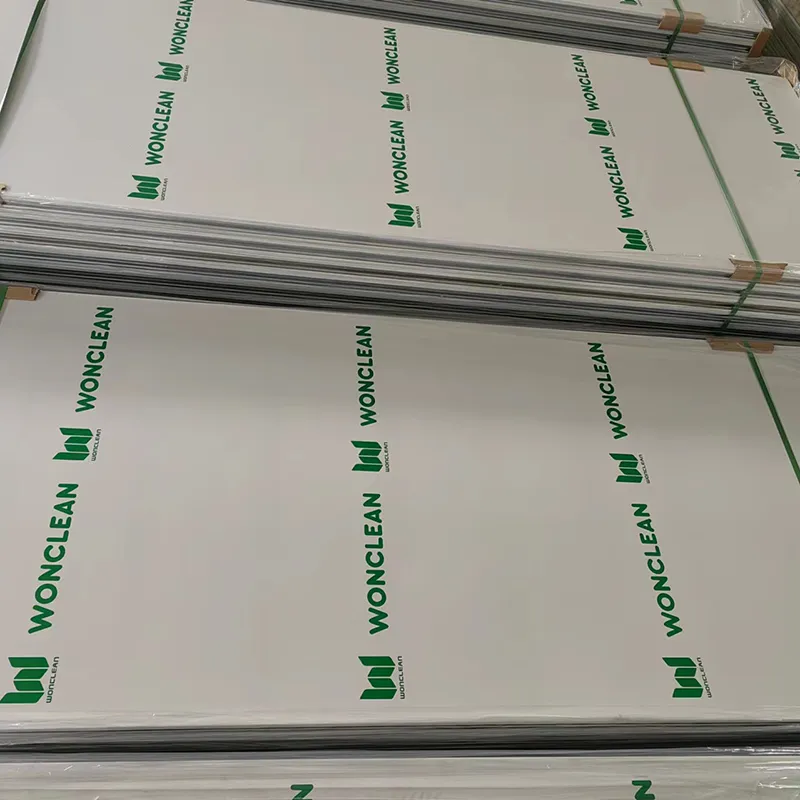
Soundproof panel: Precision-engineered for multi-industry cleanroom integrity
With over two decades of hands-on experience designing, specifying, and commissioning controlled environments across Southeast Asia and global supply chains, I’ve seen how misaligned acoustic and particulate control strategies compromise both operational reliability and regulatory compliance. The Malaysia prefabricated cleanrooms market has matured significantly—not just in speed of deployment, but in performance integration. Today’s engineering teams in semiconductor fabs, biologics manufacturing, aerospace test labs, and high-precision optics facilities no longer accept trade-offs between ISO class compliance and ambient noise attenuation. That’s why our Soundproof panel is not an add-on retrofit, but a foundational cleanroom panel engineered from the core: seamless structural rigidity, certified particulate sealing (≤0.1 µm at 99.999% efficiency), and consistent sound transmission class (STC) ≥42 across full-panel assemblies.
This isn’t generic insulation wrapped in stainless steel. Each panel integrates a constrained-layer damping core, non-outgassing polymer sealant, and fully welded perimeter framing—ensuring zero delamination under thermal cycling or vibration. As a trusted cleanroom panel manufacturer serving Tier-1 OEMs and EPC contractors, we align material science with real-world constraints: humidity swings in Malaysian tropical climates, strict VOC limits in biopharmaceutical cleanroom wall material specifications, and electromagnetic compatibility (EMC) requirements for aerospace and data center applications. Whether you’re evaluating a cleanroom panel supplier for a new Malaysia modular cleanroom systems rollout or upgrading legacy enclosures in a food & beverage Grade A filling line, this Soundproof panel delivers verified dual-domain performance—without inflating cleanroom wall panels cost through over-engineering.
Technical Specifications: Verified Performance Across Critical Metrics
| Parameter | Value | Test Standard / Notes |
|---|---|---|
| Core Construction | Triple-layer: 0.8mm 316L stainless steel | Viscoelastic damping layer | 0.8mm 316L stainless steel | Non-porous, non-fibrous, USP Class VI compliant |
| Sound Transmission Class (STC) | ≥42 (full-panel assembly, ASTM E90/E493) | Validated on 1200 × 2400 mm panels with standard cleanroom gasketed joints |
| Particulate Seal Integrity | Leak rate ≤0.001% at 50 Pa differential pressure | Per ISO 14644-3 Annex B, tested with SMPS + CPC |
| Thermal Conductivity | 0.028 W/m·K (at 23°C) | Reduces condensation risk in high-humidity environments (e.g., food & beverage processing) |
| Fire Rating | EN 13501-1 Class B-s1,d0 | No toxic smoke, low flame spread — critical for data center and automotive battery cleanrooms |
| Standard Sizes | Wall: 1200 × 2400 mm, 1200 × 3000 mm Ceiling: Custom-cut Modular cleanroom ceiling panels (Modular cleanroom ceiling panels) |
Compatible with standard T-bar and grid suspension systems |
| Surface Finish | Electropolished 316L (Ra ≤0.4 µm) or matte 2B finish | Meets biomedical cleaning validation & semiconductor particle shedding specs |
Real-World Integration: From Design to Commissioning
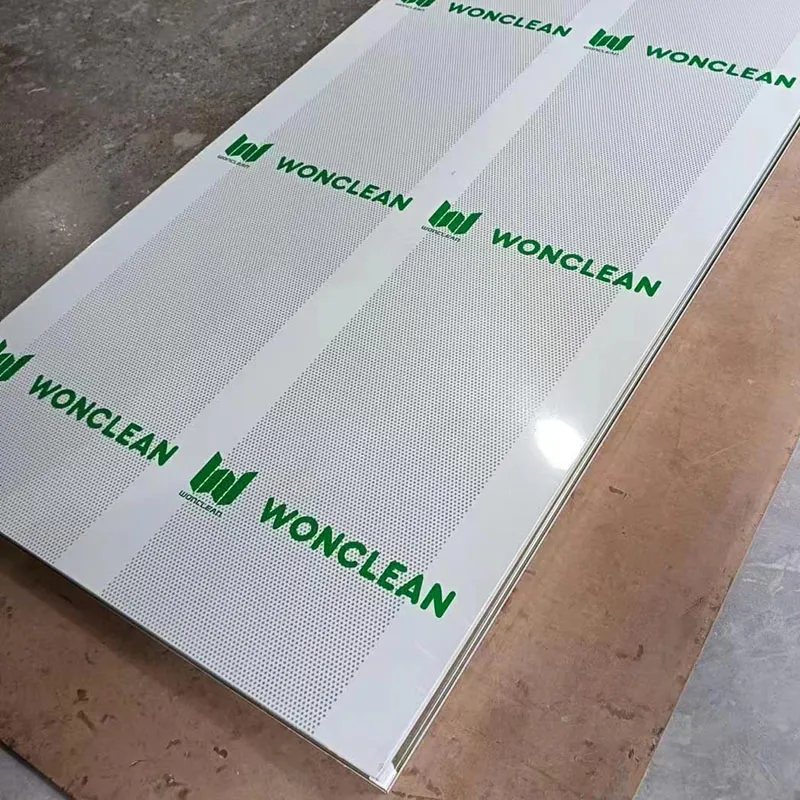
In practice, the value of a true soundproof wall panels solution reveals itself during commissioning—not on paper. For example, a Tier-1 automotive manufacturing client in Penang required ISO Class 7 assembly zones adjacent to high-speed robotic welding cells. Standard cleanroom wall panels failed STC-35 validation due to panel resonance and joint leakage. Our soundproofing wall panels resolved it in one revision: the constrained-layer core eliminated 1.2–4 kHz transmission peaks, while factory-welded corner frames ensured gasket compression uniformity across 280+ linear meters. No field rework. No schedule delay.
Similarly, a biomedical CDMO installing a new mRNA fill-finish suite needed cleanroom wall panel design that supported both EU GMP Annex 1 microbial control *and* operator hearing safety (NIOSH PEL ≤85 dBA). Instead of adding secondary acoustic cladding—which violates cleanroom airflow models and introduces contamination traps—we delivered a single-layer cleanroom wall material that met both ISO 14644-1 Class 5 and OSHA 29 CFR 1910.95 simultaneously. That’s the advantage of starting with physics, not packaging.
We work directly with engineering firms—not as a catalogue vendor, but as a specification partner. As a responsive cleanroom panel supplier, we provide full submittal packages (including fire test reports, acoustic lab data, and joint detail drawings) within 5 working days. Our cleanroom panel suppliers network supports just-in-sequence delivery to active sites across Malaysia—whether for a precision instruments & optical metrology lab in Kulim Tech Park or a new energy solid-state battery pilot line in Johor Bahru. And because Cleanroom wall panels Design impacts long-term TCO, we offer lifecycle cost modeling: comparing initial cleanroom wall panels cost against maintenance frequency, energy load (due to thermal bridging), and downtime risk from acoustic-induced sensor drift in aerospace test chambers.
If your next project demands more than “quiet walls”—but verifiable, auditable, and installable soundproof panels that uphold cleanroom fundamentals first—let’s align on technical scope before RFQ. We don’t sell panels. We deliver boundary conditions that stay within spec—day after day, year after year.
Get a project-specific quote in 24 hours
Send your cleanroom classification, floor area and finish requirements. Our Malaysia-based engineering team replies with a stamped datasheet, fire certificate and pricing — 7×24 technical support by email, phone or WhatsApp.
Chat on WhatsApp- 1 What is the proper procedure for using an air shower?
- 2 What Are the Core Materials and Specifications for Clean Room Panels?
- 3 How to Identify Reliable Manufacturers and Suppliers for Wall Systems?
- 4 What Distinguishes Partition Walls from Standard Partitioning Systems?
- 5 Specialized Panels for Green Energy and Solar Film Production?
- 6 Understanding Pricing Factors and Partition System Configurations?
- 7 How to choose the right door for a controlled environment?
- 8 Which wall panels offer the best protection against damage?
- 9 How does air purification impact clean room efficiency?
What is the proper procedure for using an air shower?
Enter, close outer door completely, stand in center, slowly rotate 360 degrees with arms raised for thorough coverage, wait for preset time (15-30 seconds), then open inner door and enter clean area
What Are the Core Materials and Specifications for Clean Room Panels?
Selecting the correct clean room panel material is critical for maintaining ISO standards across industries. Options include rock wool and aluminum. Detailed clean room panel specifications cover thickness, fire resistance, and surface smoothness. High-quality Clean room panels ensure structural integrity while meeting stringent environmental controls required for precision manufacturing processes.
How to Identify Reliable Manufacturers and Suppliers for Wall Systems?
Evaluating clean room panel manufacturers requires assessing certification records and capacity. A reputable clean room panel supplier provides support for integrating the clean room panel wall system into facilities. Teams should verify compliance with international standards before procurement. Proper selection ensures durability and minimizes maintenance costs across aerospace and automotive sectors.
What Distinguishes Partition Walls from Standard Partitioning Systems?
A clean room partition serves as a standalone divider, whereas a clean room partition wall offers structural support. Advanced clean room partitioning systems allow modular reconfiguration without compromising cleanliness. Solutions are vital for data centers and labs requiring flexible layouts. Installation must adhere to strict sealing protocols to maintain pressure differentials effectively.
Specialized Panels for Green Energy and Solar Film Production?
Facilities focusing on sustainability require clean room panels for green energy manufacturers designed with anti-static properties. Similarly, clean room panels for solar film manufacturers demand ultra-low outgassing materials. Using specialized clean room partition panels ensures product yield remains high. These support rigorous cleanliness classes needed for photovoltaic and battery production lines.
Understanding Pricing Factors and Partition System Configurations?
The clean room panel price varies based on material density, fire rating, and dimensions. A comprehensive Clean Room Partition System includes doors and profiles affecting budget. Comparing different clean room partition systems helps optimize costs without sacrificing performance. Food and beverage sectors prioritize washability, influencing final selection and expenditure planning for construction projects.
How to choose the right door for a controlled environment?
Selecting an aluminum clean room door depends on traffic flow and pressure requirements. Proper Aluminum frame door Design ensures airtight sealing to maintain pressure differentials. For high-traffic areas, automatic clean room doors reduce contamination risks by minimizing physical contact during entry and exit processes in critical zones.
Which wall panels offer the best protection against damage?
Aluminum Clean Room Wall Panels are engineered for impact resistance and easy cleaning. The Aluminium honeycomb gypsum panel combines fire resistance with structural stability. An Anti-fold special panel further enhances durability in corners, ensuring long-term performance without compromising the sterile conditions required for pharmaceutical or electronic manufacturing.
How does air purification impact clean room efficiency?
Effective air purification is critical for maintaining ISO standards. High-quality air filter units remove particulates from the circulation system. Large scale air purification projects require detailed planning regarding airflow patterns. Integration with HVAC systems ensures consistent environmental control. Monitoring particle counts validates effectiveness. Upgrading filtration media enhances safety and product quality within sensitive zones.
