






Cleanroom Equipment
Cargo Air Shower Room / Goods Air Shower Tunnel
The Cargo Air Shower Room is a heavy-duty contamination control unit designed specifically for cleaning pallets, cartons, drums, equipment, and raw materials before they enter a cleanroom or controlled environment. It directs high-velocity HEPA-filtered air through adjustable nozzles to remove dust,
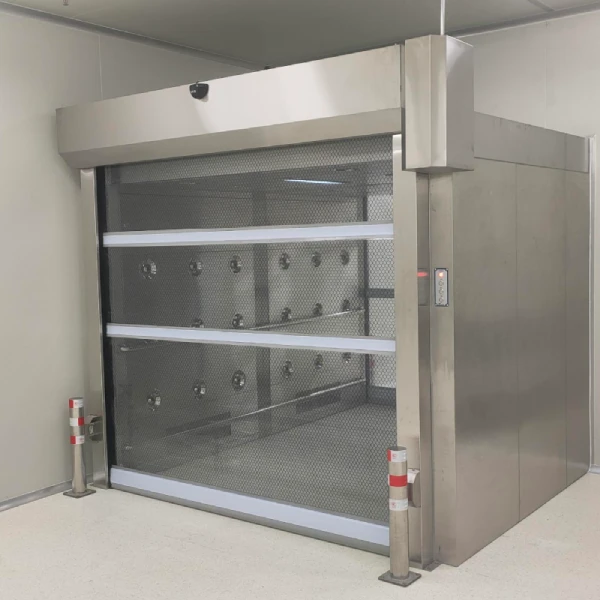
Cargo Air Shower Room / Goods Air Shower Tunnel: Precision Entry Control for High-Integrity Environments
With over two decades of hands-on experience designing, specifying, and validating cleanroom infrastructure across semiconductor fabs, biologics manufacturing suites, and aerospace assembly lines, I’ve seen how a single point of contamination—especially at material transfer zones—can cascade into yield loss, regulatory findings, or costly requalification. The Cargo Air Shower Room / Goods Air Shower Tunnel is not just another air curtain or blow-off station. It’s an engineered interface between uncontrolled and classified spaces—designed to remove ≥99.97% of ≥0.3 µm particles from cartons, trays, tooling, wafers, glass substrates, and stainless-steel components before they enter ISO Class 5–8 environments.
This solution aligns with the core expectations of engineering teams in Malaysia’s rapidly scaling semiconductor & electronics clusters (e.g., Kulim, Penang), biopharma & life sciences facilities supporting clinical-grade fill-finish and cell therapy logistics, aerospace MRO hubs handling optical sensor assemblies, and precision optics & instrumentation labs where sub-micron particulates compromise lens coatings or interferometer stability. It also meets the growing demand in food & beverage co-packaging lines (e.g., sterile dairy filling), automotive EV battery module assembly, data center hardware staging areas, and new energy R&D labs working with perovskite cells or hydrogen catalysts—all of which require validated particle reduction at goods entry points.
Unlike field-built enclosures or retrofitted cabinets, our Malaysia prefabricated cleanrooms and Malaysia modular cleanroom systems integrate seamlessly with this tunnel. The Cargo Air Shower Room / Goods Air Shower Tunnel is supplied as a fully tested, pre-wired, and factory-balanced unit—reducing on-site commissioning time by up to 65%. As a trusted air shower supplier serving regional engineering firms since 2004, we prioritize interoperability, serviceability, and lifecycle cost transparency—not just upfront air shower clean room price or air shower price. You’ll find our air shower cleanroom design reflects real-world constraints: floor loading limits, ceiling height clearance, integration with existing HVAC interlocks, and compatibility with automated guided vehicles (AGVs) or conveyor interfaces.
Technical Specifications & Configuration Options
| Parameter | Standard Configuration | Optional Upgrades |
|---|---|---|
| Chamber Dimensions (L × W × H) | 2,400 × 1,200 × 2,100 mm (custom lengths up to 6 m) | Width extension to 1,500 mm; height to 2,400 mm |
| Door Type & Interlock | Dual automatic sliding doors (stainless steel 304), fail-safe electro-mechanical interlock | Explosion-proof rated doors (ATEX Zone 2); RFID-triggered access |
| Air Velocity & Nozzle Layout | 22–25 m/s at nozzle exit; 36 nozzles (18 per side), adjustable angle | Variable-frequency drive (VFD) control; 48-nozzle high-density layout |
| Filter Efficiency | HEPA H14 (EN 1822), 99.995% @ 0.1 µm | ULPA U15 (99.9995% @ 0.1 µm) for ISO Class 4/5 buffer zones |
| Cycle Time & Control | 10–30 sec programmable; touch HMI with audit trail (CSV-ready) | Integration with MES/BMS via Modbus TCP; particle counter feedback loop |
| Materials & Finish | Interior: 304 SS walls/ceiling; exterior: powder-coated mild steel | Full 316L SS construction; anti-static epoxy floor; UV-C lamp option |
Real-World Application & Integration Guidance
In practice, the Cargo Air Shower Room / Goods Air Shower Tunnel replaces ad-hoc staging tables, manual wipe-down stations, or undersized Single-Person Air Shower Room units repurposed for cargo—a common but non-compliant workaround. For example: a Penang-based semiconductor subcontractor reduced wafer carrier contamination events by 82% after installing a 4.2 m tunnel linked to their Multi-Person Air Shower Room / Air Shower Tunnel for personnel and a dedicated cargo lane. Similarly, a Johor biotech CDMO uses the tunnel to decontaminate single-use bioreactor bags and filtration cassettes before entry into Grade B filling suites—eliminating the need for double-bagging and reducing operator handling time by 40%.
Key integration considerations we advise engineering teams on:
- Air shower for cleanroom placement must avoid recirculation into adjacent corridors—minimum 1.5 m clearance from HVAC returns is recommended;
- Confirm static pressure differential (≥15 Pa) between tunnel and cleanroom is maintained during door transitions—our air shower systems include built-in damper compensation;
- For air showers for clean rooms handling sensitive optics or lithium-ion battery modules, specify non-ionic airflow and ESD-safe materials (surface resistivity 10⁴–10⁶ Ω/sq);
- All units are supplied with full FAT documentation, including airflow visualization reports and filter leak test certificates—critical for MHRA, FDA, or ISO 14644-1 acceptance;
- We support air shower cleanroom validation protocols (IQ/OQ/PQ) and offer certified air shower manufacturers training for in-house maintenance teams.
Whether you’re evaluating options for a new fab build, upgrading legacy material airlocks, or specifying for a GMP Annex 1-aligned facility, the Cargo Air Shower Room / Goods Air Shower Tunnel delivers predictable, auditable, and scalable particle control—without compromising throughput. As a long-standing air shower supplier to regional engineering consultancies and EPC contractors, we focus on what matters most: compliance integrity, operational resilience, and total cost of ownership—not just the headline air shower room design or air shower room footprint. Explore our full range of validated solutions—including Single-Person Air Shower Room and Multi-Person Air Shower Room / Air Shower Tunnel—to match your workflow, classification needs, and budget rigor.
Get a project-specific quote in 24 hours
Send your cleanroom classification, floor area and finish requirements. Our Malaysia-based engineering team replies with a stamped datasheet, fire certificate and pricing — 7×24 technical support by email, phone or WhatsApp.
Chat on WhatsApp